How Long Should A Loading Ramp Be?
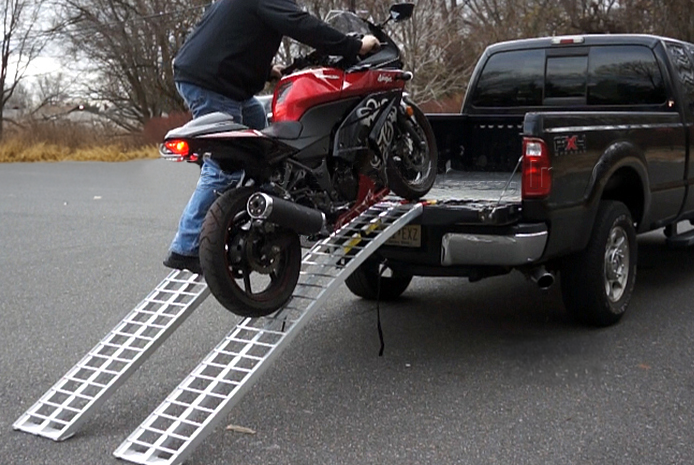
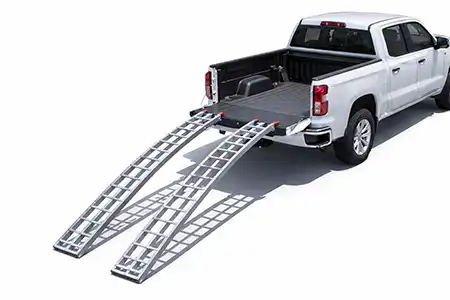 The height of the truck bed, trailer deck, or dock determines the ramp angle for a given ramp length. A shorter ramp on a tall surface creates a steep angle that is harder to drive up and increases the chance of a vehicle high-centering during the transition from ramp to deck. A longer ramp reduces the angle and makes loading easier and safer.
Do not focus only on weight rating. A longer ramp creates a smoother incline, which helps prevent scraping and makes loading easier.
How Do I Calculate The Loading Ramp Length?
1. Measure the Load Height
Measure the distance from the ground to the top of the tailgate, trailer bed, or dock where the ramp will rest. Ensure the vehicle is on level ground when taking this measurement.
2. Determine the Desired Load Angle
Load Angle represents the angle in degrees between the base surface (ground, pavement etc.) and the ramp. It is determined by the equipment you are loading and the type of ramps to be used:
Wheelchairs: The ADA’s maximum recommended slope is 1:12 (12″ of horizontal run for every 1 inch of rise) for occupied wheelchairs. This equates to a load angle of 4.75 degrees. Unoccupied wheelchairs may be treated as equipment, allowing for shorter ramps.
Mowers, Autos, Street Bikes & Golf Carts: These are often low clearance equipment and prone to high centering. Arched ramps are highly recommended. Load angles of 16 to 20 degrees are common. Only square end ramps (no chamfered foot) may be used below 20 degrees load angle. You must also check your equipment’s owner manual for its maximum grade capability to prevent tipping or stalling.
ATV / UTV’s, Trucks & Off Road Vehicles: High clearance equipment permit higher load angles. Load angles of 21 to 25 degrees are common but please check your equipment’s owner manual for its maximum grade capability to prevent tipping or stalling.
Walking Equipment Up: If you are walking a machine up using its own power, a steeper incline (shorter ramp) may be used than if you are pushing it manually. Consider our Double Tread Rod or Tread Bar surface options for walking equipment.
3. Apply the Formula
The recommended ramp length is calculated as Length = Load Height / sine(Load Angle).
For example, if you have a 24-inch rise and want a safe 22 degree load angle, the ramp length would be 24″ / sine(22) = 64″ or 5′ 4″. It is best practice to round up to the next foot increment so a 6′ ramp would be recommended.
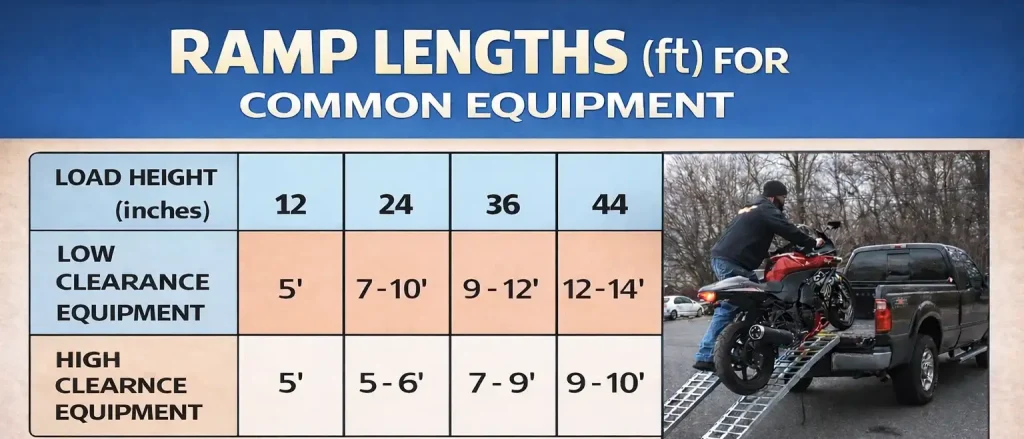
Quick Reference for Loading Height
The table below lists common ramp lengths for typical pickup trucks and trailers:
Which Type Of Loading Ramp Should I Buy?
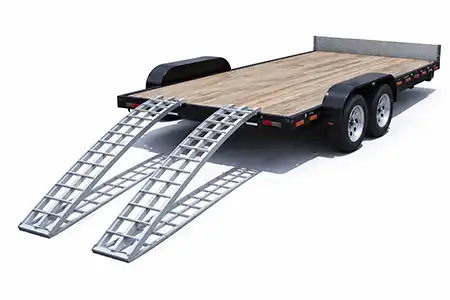
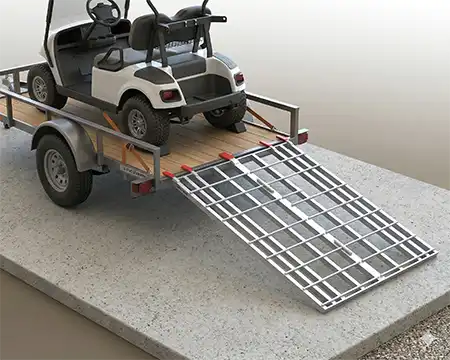 Ramp shape plays a big role in performance. Arch ramps help prevent high centering and are ideal for low-clearance equipment. Straight ramps are easier to store due to their lower profile. Folding ramps provide convenience and fixed-width loading.
1st considerations:
- If the equipment is low, start with arch.
- If vertical storage space is tight, consider straight.
- If the customer wants one ramp instead of two, look at bifold or trifold.
ARCH RAMPS
Our Arch Ramps are designed to handle the widest range of applications. The curved design helps reduce the chance of high centering when loading equipment with low ground clearance. This makes them a strong choice for:
- Golf carts
- Race cars
- Zero-turn mowers
- Skid steers
- Garden tractors
- Tool cabinets
- And equipment that sits low between the axles
If your equipment sits low, an arch ramp helps reduce the chance of scraping as you transition from the ramp to the truck or trailer.
STRAIGHT RAMPS
Our Straight Ramps offer the same core function as arch ramps but without the curved profile. The main advantage is reduced overall height, typically 3″, which makes them easier to store as slide-outs or under your equipment.
Straight ramps give you a simple, low-profile option that is easier to store while still handling most loading needs.
FOLDING RAMPS
Our Folding Ramps perform just like our arch and straight pair ramps but fold end-to-end for convenience. They are easier to store, transport and deploy than pair ramps, especially in the longer lengths. Unlike the competition, we design and manufacture our hinge components, so our folding ramps are just as durable as our standard pair ramps. Don’t want your 8′ pair ramps sticking out of the truck bed? Get 8′ folding ramps and they’ll lay flat.
BIFOLD RAMPS
Our Bifold Ramps fold in half for transport and storage, then open into one fixed-width loading surface. This eliminates the need to position two separate ramps and makes setup faster and more consistent. These are commonly used for:
- ATVs
- Mowers
- And four-wheel equipment
With a fixed width, Bifold Ramps are convenient but must fit the equipment width. They are less universal than pair ramps.
TRIFOLD RAMPS
Our Trifold Ramps fold into a compact size for transport and open into a wider fixed loading surface than bifold models. They are designed for convenience and ease of use, especially when a wider platform is needed. For three-wheel or offset wheel applications, models with a full center section are the correct choice.
A trifold ramp gives you a wider loading surface that still folds down for easy storage and transport.
Why Buy From Five Star Manufacturing?
 We have been building aluminum products in the United States since 1984, and that experience shows up in the way our products perform in the real world. We are not a reseller or an importer. We design and manufacture our own products, which gives us full control over quality, consistency, and availability.
We are a dealer-first company. We do not sell direct to the public, which means we are focused on supporting our dealers, not competing with them. We also offer drop-ship capabilities to help dealers expand their product offering without taking on additional inventory.
Our product lines are built around real applications, not just specifications on paper. Whether it is ramps, carriers, auto body equipment, or agricultural products, everything we build is designed to be durable, dependable, and easy to use.
Why Use Five Star Mfg Aluminum Loading Ramps?
We use 6000 series, tempered aluminum for strength without the extra weight. That means our ramps are easier to handle, easier to transport, and easier to set up compared to heavier steel alternatives.
Aluminum also resists rust and corrosion, which is a major advantage in outdoor, wet, and harsh environments. You get a longer-lasting product with less maintenance over time.
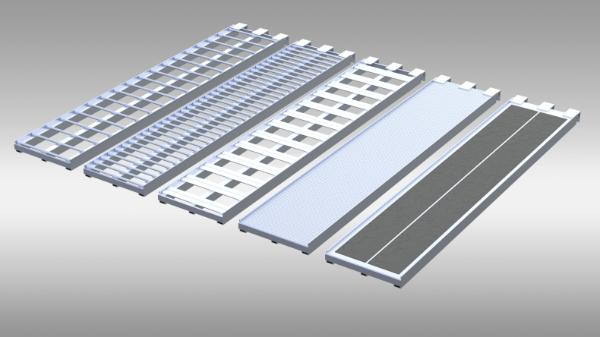
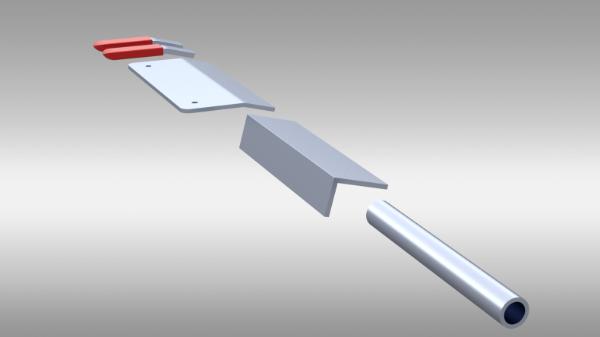
Our ramp designs are built for real-world use. Options like arch ramps help reduce the risk of high centering when loading low-clearance equipment. Multiple surface options allow you to match the ramp to the type of wheels or casters being used. Different end supports ensure proper connection to trucks, trailers, or docks.
When you combine lightweight handling, corrosion resistance, and application-specific design, aluminum ramps deliver a safer, more efficient loading experience that holds up over time.